
What Probate Covers in Pulaski County
Pulaski Probate Court is the local Probate Court for Hawkinsville and Pulaski County. The county directory lists Judge Jeffrey Jones and places the office at 141 Commerce Street, Hawkinsville, GA 31036, with phone number (478) 783-2061. Georgia court-structure sources describe Probate Court jurisdiction as including probate of wills, administration of estates, appointment of guardians, involuntary hospitalizations, issuance of pistol licenses, and marriage licenses.
The official Pulaski Probate Court page highlights marriage licenses, weapons carry licenses, probate forms through the Georgia Probate Court website, and traffic fines through EZCourtPay. That means a person looking for "probate records" may be dealing with a traditional estate file, a will filing, a guardianship petition, a marriage-license record, a weapons carry application, or a local traffic matter routed through the Probate Court office.
The official Pulaski Probate Court page is the local source for Probate Court contact details, marriage-license fees, forms routing, traffic fine routing, and weapons carry information.
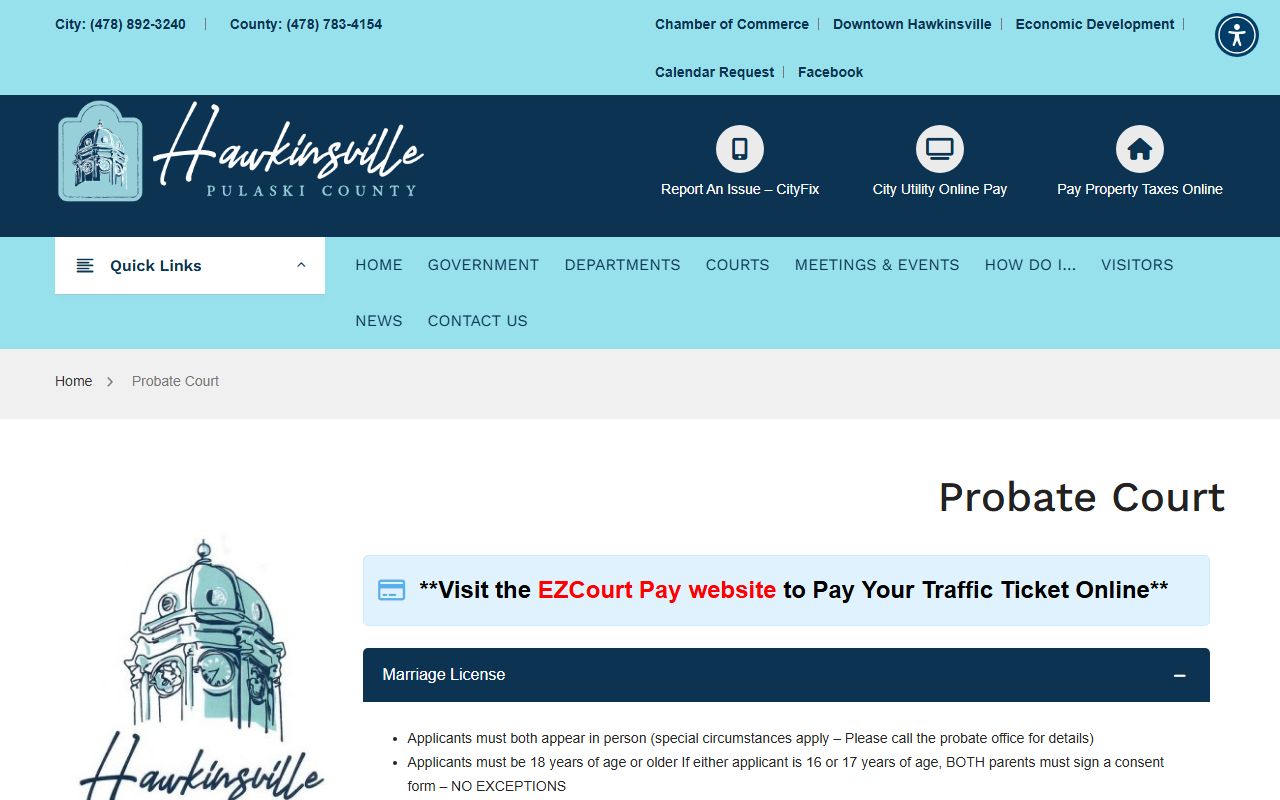
The local page is important because statewide portals do not replace the county office for questions about filings, certified copies, current procedures, or records that are not searchable online.
Probate Terms Defined
Probate filings use formal terms that identify the person who died, the person asking for authority, the property being administered, and the type of protection being requested for another person. These definitions help separate estate records from guardianship, conservatorship, and other Probate Court files.
- Testator
- The person who made a will.
- Executor
- The person named in a will to carry out the will, subject to Probate Court authority.
- Administrator
- A person appointed to handle an estate when there is no will or when an executor is not serving.
- Intestate
- Dying without a will, which changes the estate process and who may receive notice.
- Letters
- Court-issued authority showing that a personal representative may act for the estate.
- Guardianship
- A proceeding about care, decision-making, or personal rights for a minor or adult under Probate Court rules.
- Conservatorship
- A proceeding focused on management of another person's property or financial affairs.
How to Search Pulaski County Probate Court
The main online access point is Georgia Probate Records. Its tile interface includes Search Estate Information, Search Recorded Marriage Licenses, Search Traffic Dockets, Search Will Information, Search Guardianship Petitions, Enter Marriage Application, Search Death Information, Hearings And Traffic Calendar, Search Miscellaneous Filings, Enter Weapons Carry License, Calculate Petition Filing Fees, and View Probate Court Information. Use the tile that matches the record type instead of assuming one probate search covers every file.
The Georgia Probate Records portal displays the statewide probate search and application tiles used for estate, marriage, will, guardianship, death, calendar, miscellaneous, weapons carry, and fee-calculator tasks.
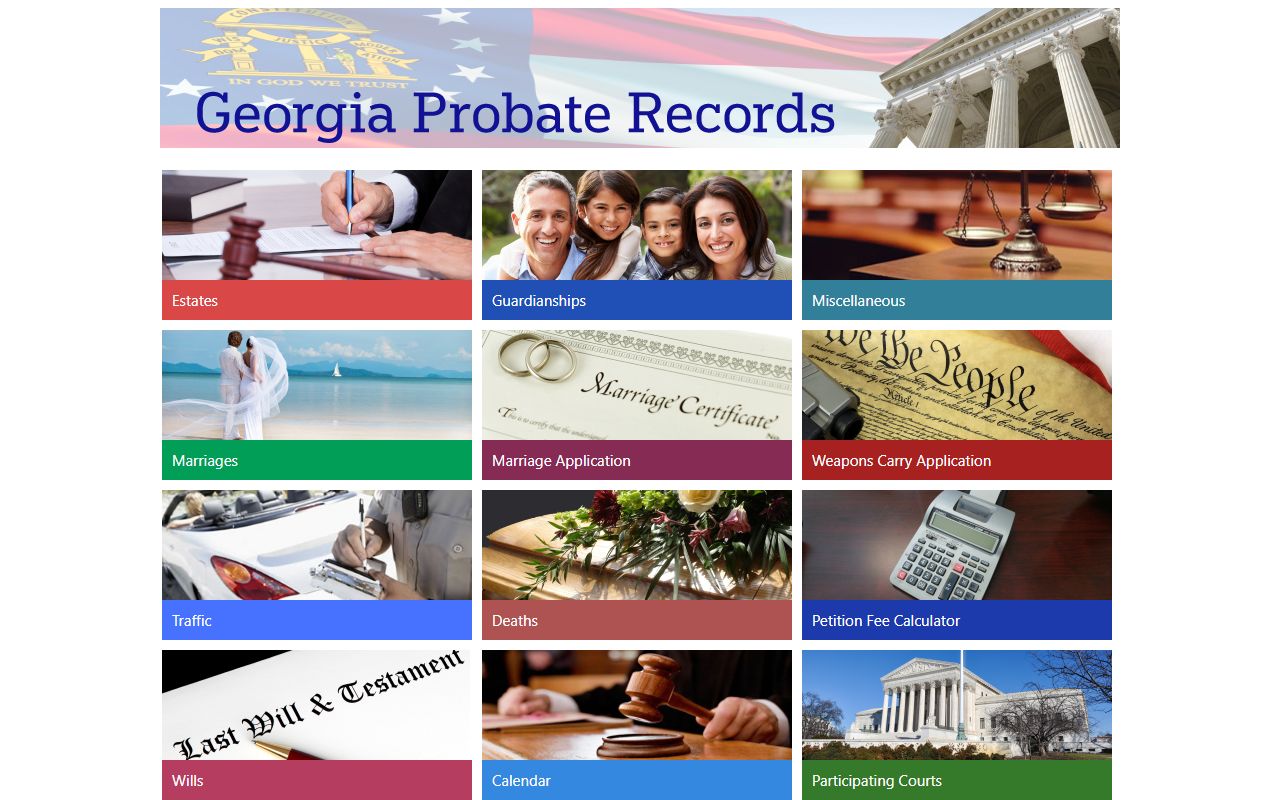
The portal is a useful starting point, but the research file notes that Pulaski-specific probate petition fees were not located in official sources and that older files, sealed matters, and copy requests may still require direct Probate Court contact.
- Identify the matter type: estate administration, will, guardianship, conservatorship, marriage or vital record, weapons carry, traffic docket, death information, miscellaneous filing, or calendar/hearing lookup.
- Open the matching Georgia Probate Records tile if the task is available online.
- Search with the available party, estate, will, docket, or filing information shown in that module.
- For a new filing, choose the correct Supreme Court of Georgia standard probate form or the appropriate Probate Court application workflow.
- Call Pulaski Probate Court at (478) 783-2061 when a file is older, restricted, not found in the portal, or needed as a certified copy.
Probate Filing Steps
Probate filings are not all the same. An estate administration, a will in common form, a will in solemn form, a guardianship petition, and a conservatorship inventory use different forms and notice requirements. The research file identifies the Supreme Court of Georgia standard probate forms as the statewide form source for common filings.
- Identify whether the matter is an estate, will, guardianship, conservatorship, marriage, weapons carry, traffic, or another Probate Court matter.
- Select the appropriate standard form or portal application. Common examples include GPCSF 2 for temporary letters of administration, GPCSF 3 for letters of administration, GPCSF 4 for probate of will in common form, and GPCSF 5 for probate of will in solemn form.
- File with Pulaski Probate Court at 141 Commerce Street or follow the online portal instructions when the specific module supports online entry.
- Pay required filing fees. If a petition amount is not published locally, use the Georgia Probate Records petition fee calculator or confirm with Probate Court.
- Follow required notice or service steps for heirs, beneficiaries, wards, or interested parties.
- Attend any hearing required by the Probate Court. Georgia Probate Records includes a hearings and traffic calendar tile.
- Request letters, orders, or certified copies from Probate Court after the filing is accepted or the order is entered.
Probate Courts in Pulaski County
Pulaski County has one Probate Court office identified in the research file. The same courthouse location is also listed by the Georgia Department of Public Health as a Pulaski County vital-records office. Probate matters should not be routed to the Clerk of Superior Court unless the issue is actually a Superior Court case, such as divorce.
Pulaski County Probate Court
Judge Jeffrey Jones
141 Commerce Street
Hawkinsville, GA 31036
(478) 783-2061
Hours not located in the official Probate Court source inspected
Probate Filing Fees
The research file did not locate a Pulaski-specific probate petition fee schedule in the official local sources. Georgia Probate Records includes a Calculate Petition Filing Fees tile, so that calculator and the Probate Court office are the supported fee-confirmation routes for estate, will, guardianship, and conservatorship petitions. Marriage-license fees are published locally.
| Item | Amount |
|---|---|
| Estate petition filing | Fee not located in official Pulaski sources; use Georgia Probate Records petition fee calculator |
| Will filing or probate petition | Fee not located in official Pulaski sources |
| Guardianship petition | Fee not located in official Pulaski sources |
| Certified probate copy | Fee not located in official Pulaski sources |
| Marriage license without premarital counseling | $66 |
| Marriage license with premarital counseling certificate | $26 |
What Pulaski County Probate Records Show
Estate and will files may show petitions, wills, letters, orders, notices, heir or beneficiary information, inventories, accountings, discharge petitions, and other filings tied to administration of a decedent's property. Guardianship and conservatorship records may show petitions, appointment orders, inventories, asset-management plans, final settlement documents, or restoration filings, depending on the case type and what the court allows the public to see.
The Supreme Court standard form list reflects the types of records a probate file may generate. Examples in the research file include GPCSF 1 General Instructions, GPCSF 2 Petition for Temporary Letters of Administration, GPCSF 3 Petition for Letters of Administration, GPCSF 4 Petition to Probate Will in Common Form, GPCSF 5 Petition to Probate Will in Solemn Form, GPCSF 33 Petition for Discharge of Personal Representative, GPCSF 58 Adult Conservatorship Inventory and Asset Management Plan, and GPCSF 65 Petition for Termination of Guardianship or Conservatorship and Restoration of Rights.
The Supreme Court of Georgia probate standard forms page lists statewide probate forms used for estate, guardianship, conservatorship, and supplemental filings.
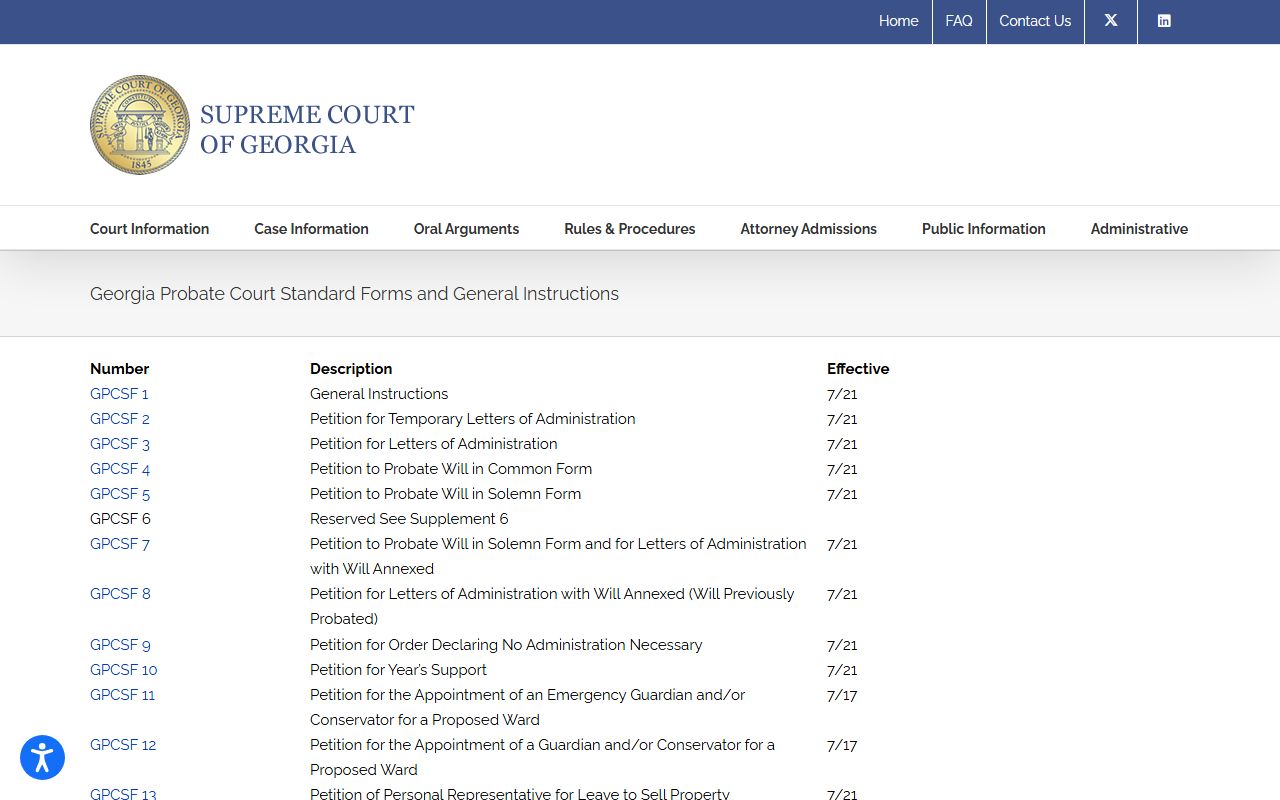
Those forms are a practical checklist for the types of documents that may appear in a probate file, but the presence of a form in the statewide list does not mean every Pulaski file will contain that document.
Restricted Probate Court Records
Not every Probate Court matter is open in the same way as an ordinary estate file. Involuntary hospitalization matters involve sensitive health information and should be treated as restricted. Guardianship and conservatorship matters may include private medical, financial, minor, or protected-person information. Public copies may also redact personal identifiers, financial-account numbers, minor names, addresses, and similar protected data.
Georgia court records are public unless access is limited by law or by a court sealing process, but that public-access principle does not make restricted probate, mental-health, adoption, juvenile, or sealed material freely searchable. If a portal result is missing or incomplete, the reason may be a restriction rather than a data error. The proper next step is to ask Pulaski Probate Court what access, if any, is available to parties, attorneys, guardians, heirs, beneficiaries, or people with a court order.
Probate Court also overlaps with marriage licenses, weapons carry licenses, and local traffic handling. Marriage records and applications have their own rules and fees. Weapons carry applications are entered through the Georgia Probate Records portal tile, but the research file does not provide Pulaski-specific application-detail fields beyond the portal tile. Traffic matters may route to Georgia Probate Records traffic docket functions and EZCourtPay payment channels, while Georgia court sources caution that the state does not have one central traffic citation database.